
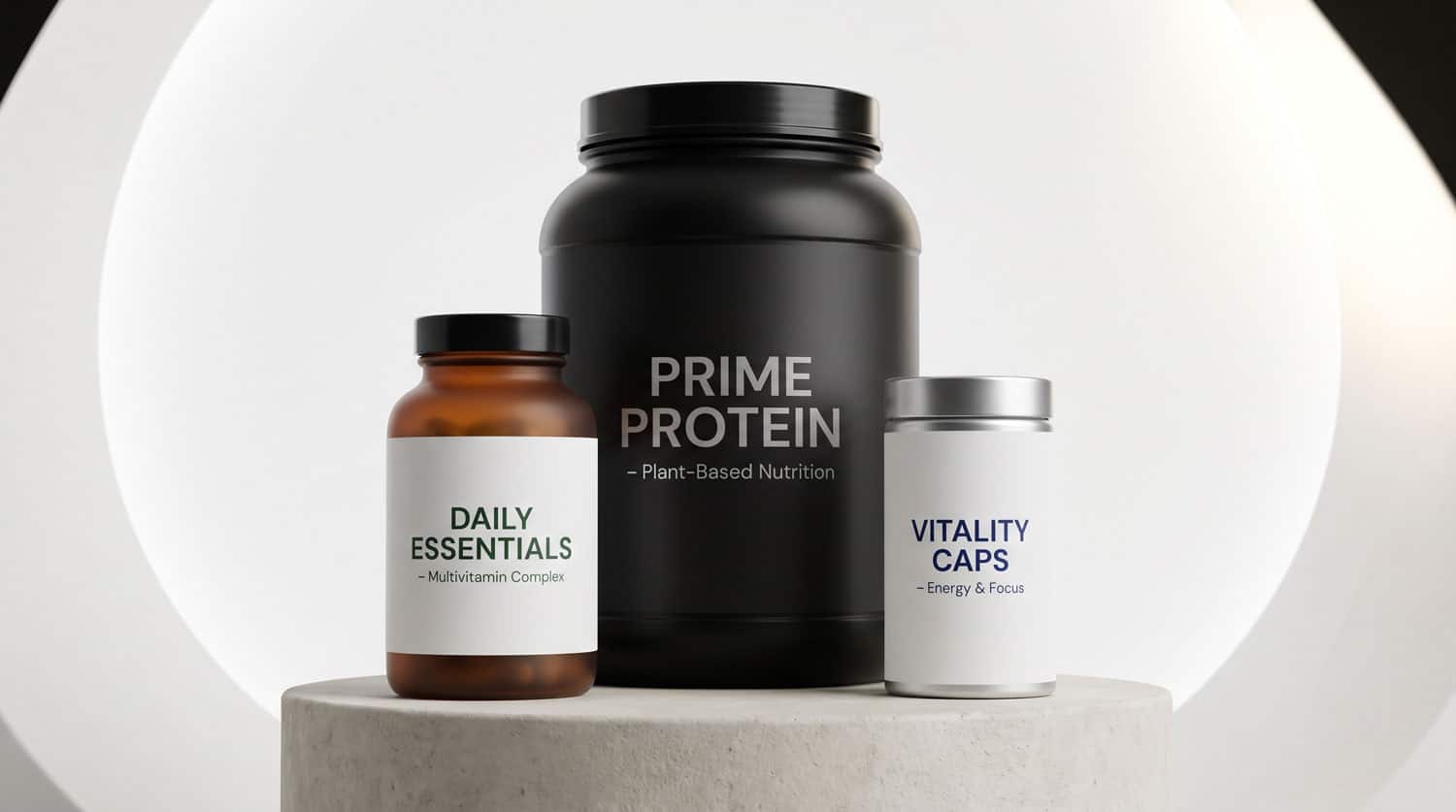
Why Supplement Product Photography Is Harder Than It Looks
Supplement product photography UK covers one of the most technically demanding categories in e-commerce. The products look simple: a tub, a bottle, a pouch. But the combination of reflective packaging, label-heavy branding, complex regulatory restrictions on health claims in imagery, and the sheer volume of competition on Amazon and DTC stores makes it genuinely difficult to get right.
Most supplement brands have experienced the same problem: they send their products to a generalist photographer, the images come back technically acceptable, and yet the listings still underperform. The photography is fine. It is just not doing the job that supplement product photography in the UK needs to do.
This guide covers what professional supplement product photography involves, where generic approaches fall short, how the hybrid studio and AI workflow changes the economics for brands with large ranges or multiple SKUs, and what compliance requirements affect imagery in this category specifically. If you are looking for a UK studio that handles supplement product photography from packshot through to AI-enhanced lifestyle scenes, this covers exactly what to look for.
The Supplement Market Is Crowded. Your Images Are the First Filter.
The UK dietary supplements market was valued at £3.8 billion in 2023 and is growing steadily, with e-commerce now accounting for around 40% of sales. Amazon UK is the dominant marketplace channel for most supplement brands, and the competition on any given search page is fierce. Protein powders, vitamins, and wellness blends all compete against dozens of visually similar products at similar price points.
In that environment, your images do more than describe the product. They communicate trust, signal quality, and position your brand before a buyer reads a word of copy. A supplement with poor imagery is effectively invisible: shoppers do not give it the benefit of the doubt, because there are too many alternatives one scroll away.
Professional supplement product photography UK addresses this at every stage of the buying decision, from the thumbnail on a search results page to the secondary images that answer a buyer’s specific questions before they add to basket.
What Supplement Photography Actually Involves
Supplement packaging presents specific technical challenges that distinguish this category from general product photography. Understanding them explains why not every studio is well-suited to this work.
Reflective and glossy packaging
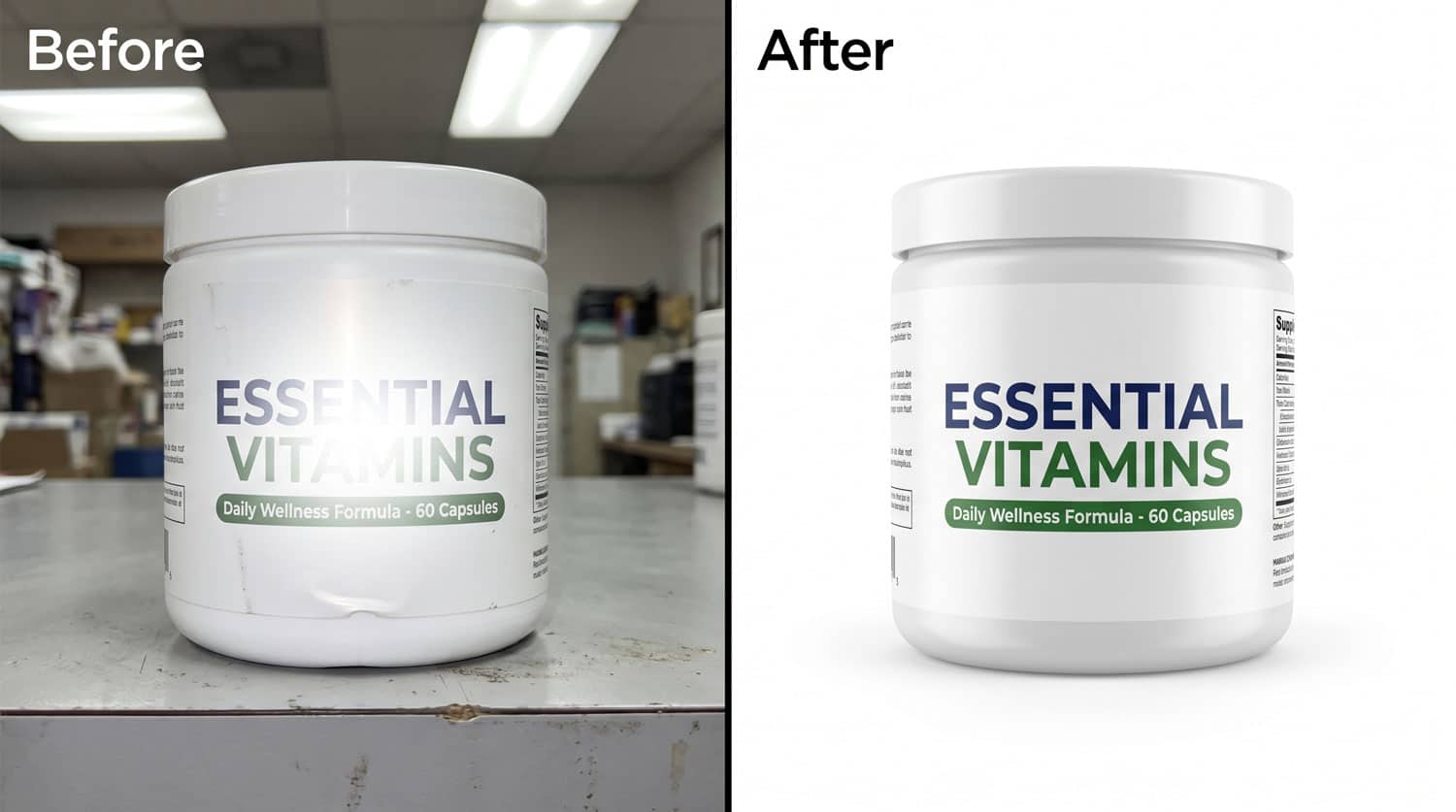
Most supplement packaging (plastic tubs, glass bottles, foil pouches, metallic capsule pots) has a reflective surface. Light hits these materials differently than it does matte products, and managing the reflection without losing label clarity or creating hot spots requires precise control of both the light source and the environment around the product. A photographer who routinely shoots matte-finish homeware will often produce supplement shots with glare across the label, the brand name partially obscured, or harsh shadows that flatten the shape.
Label accuracy and readability
Supplement labels carry legally required information: ingredient lists, nutritional panels, serving sizes, batch numbers. In the studio, every label must sit flush, with no peeling at the edges, no bubble from moisture, and enough depth of field to keep text sharp at the scale it will appear on screen. Brands have listings flagged and suspended on Amazon UK because label text in their main image was illegible or the nutritional panel was obscured.
Transparent and semi-transparent containers
Clear capsule bottles, glass supplement pots, and soft-gel containers require backlighting or side lighting techniques to reveal both the packaging and the product inside. This is a compositing challenge as much as a lighting one: often requiring multiple exposures that are combined in post to achieve a result where the capsules are visible and the label is accurate.
Multiple SKUs and variants
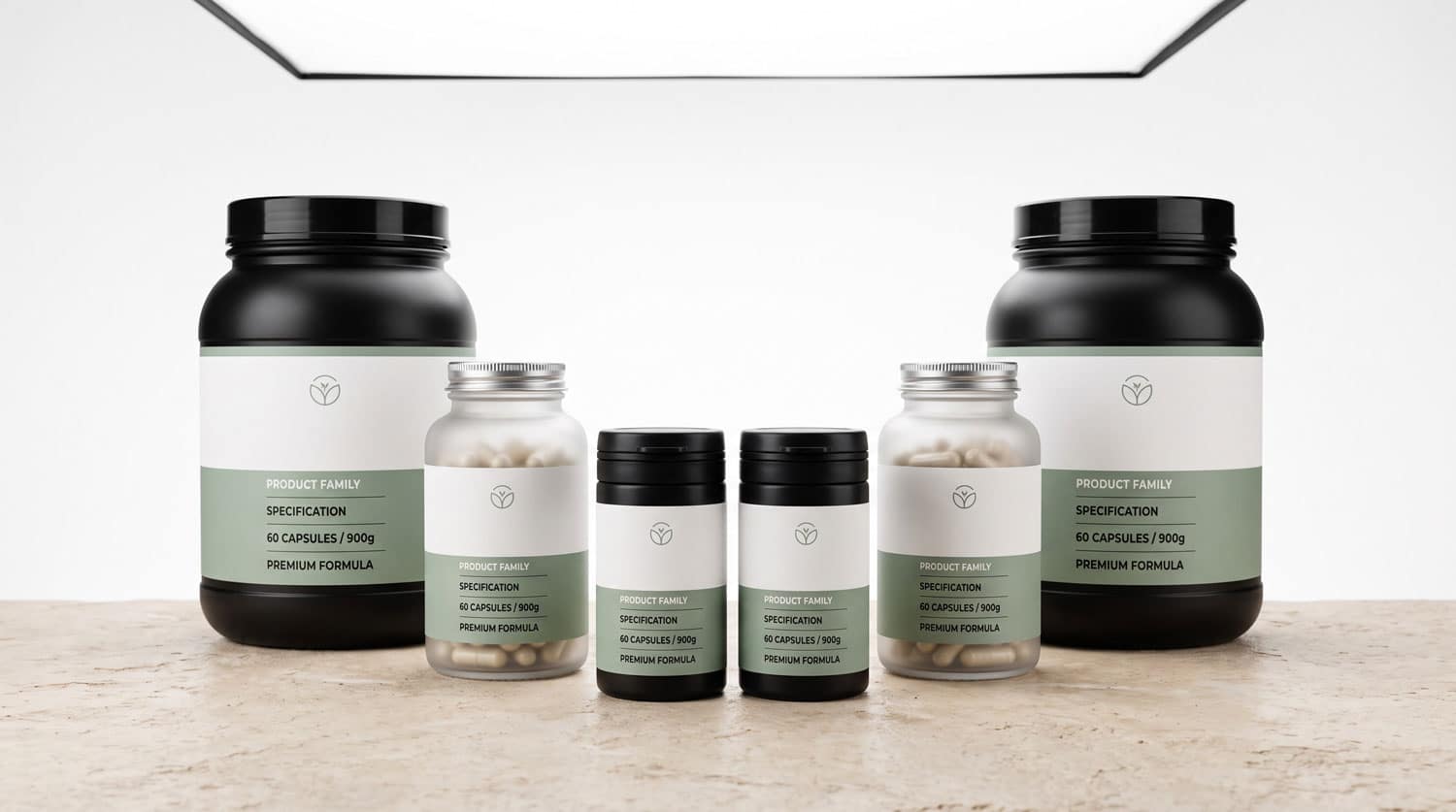
Supplement brands rarely sell one product. A vitamin range might have twelve flavours; a sports nutrition brand might offer five formats of the same protein powder. Consistency across the full range is as important as the quality of any single image. Buyers compare variants on the same page, and inconsistent lighting, angles, or background tones immediately undermine the premium positioning most brands are trying to build.
Shot Types Every UK Supplement Brand Needs
A complete supplement photography package covers several distinct image types, each serving a different purpose in the conversion journey.
| Image type | Purpose | Where it appears |
|---|---|---|
| Amazon-compliant main image | White background, 85% product fill, no props or text | Amazon main image slot (required) |
| Angled packshot | Shows three-dimensional form, lid and base detail | Secondary images, product pages |
| Label close-up | Confirms ingredient and nutritional information | Secondary images, DTC product pages |
| Range shot | Shows full product family together | Brand header images, social, retail |
| Lifestyle (ritual context) | Morning routine, post-workout, desk, kitchen counter | Secondary images, ads, social media |
| Ingredient detail | Raw ingredients alongside packaging (berries, capsules poured) | Secondary images, brand storytelling |
| Infographic layer | Key benefits, serving size, usage instruction overlaid on image | Amazon secondary images, DTC pages |
Most supplement brands underinvest in secondary images, despite these being where most purchasing decisions are made. If your Amazon listing stops at two or three images, your photography is not doing its job. Amazon allows up to nine images per listing: brands that use all nine consistently outperform those that do not.
Compliance: What Supplement Imagery Can and Cannot Show in the UK
This is where supplement photography diverges sharply from most other product categories. The MHRA (Medicines and Healthcare products Regulatory Agency) and the ASA (Advertising Standards Authority) both regulate what can be implied or stated through imagery in the supplement space, and the rules apply to visual elements as much as to copy.
The key restrictions to understand:
-
No implied medical claims through imagery. Before-and-after comparisons, scales, measuring tape, clinical charts, or imagery that implies a health outcome will draw regulatory attention and can cause ad campaigns to be rejected or suspended. This applies to visual implication, not just text.
-
No imagery that misleads about the product’s nature. A supplement cannot be visually presented in a way that implies it is a licensed medicine.
-
Amazon’s specific supplement imagery requirements. The main image must meet the standard Amazon white background specification. Amazon UK applies additional scrutiny to imagery in the Health and Beauty category: images that appear to make unauthorised health claims through text overlays or implied outcomes in lifestyle contexts will trigger listing suppression.
-
Ingredient accuracy. If a lifestyle image shows specific ingredients alongside the product (fresh berries for a vitamin C supplement, oats for a protein powder), those must genuinely reflect the product’s contents. Misleading ingredient imagery creates both regulatory risk and customer trust issues.
The practical implication is that supplement lifestyle photography requires a level of creative discipline that most generalist photographers are not set up to apply. The brief needs to be written with compliance in mind before the shoot, not reviewed for compliance after the images come back. The ASA’s guidance on health and beauty claims sets out what is and is not acceptable in visual advertising for this category.
For brands selling on Amazon UK specifically, the rules governing what imagery Amazon will and will not accept go beyond supplement-specific restrictions and are worth understanding in full before any photography is commissioned.
Where AI Changes the Economics for Supplement Brands
The core challenge for most supplement brands is volume. A brand with ten products and five flavour variants each needs a considerable number of images across multiple channels. Amazon requires up to nine images per listing, DTC product pages need their own sets, social media demands regular fresh content, and paid ads need constant creative variation for testing.
Producing all of that through traditional studio photography alone is expensive and slow. This is where the hybrid approach (studio photography as the foundation, AI-enhanced imagery to scale the output) changes the maths significantly.
What the studio shoot produces
A studio session for a supplement brand typically yields accurate packshots in multiple configurations, a label close-up, a range shot, and the technical base images required for Amazon compliance. This is work that requires a real product photographed under controlled conditions. There is no shortcut here, and AI tools cannot replace it. The product must be physically shot to ensure label accuracy, correct colour rendering, and material fidelity.
What AI adds after the studio session
Once the studio packshots exist, AI image generation can extend the asset library substantially without additional shooting. The most effective applications in the supplement category are:
-
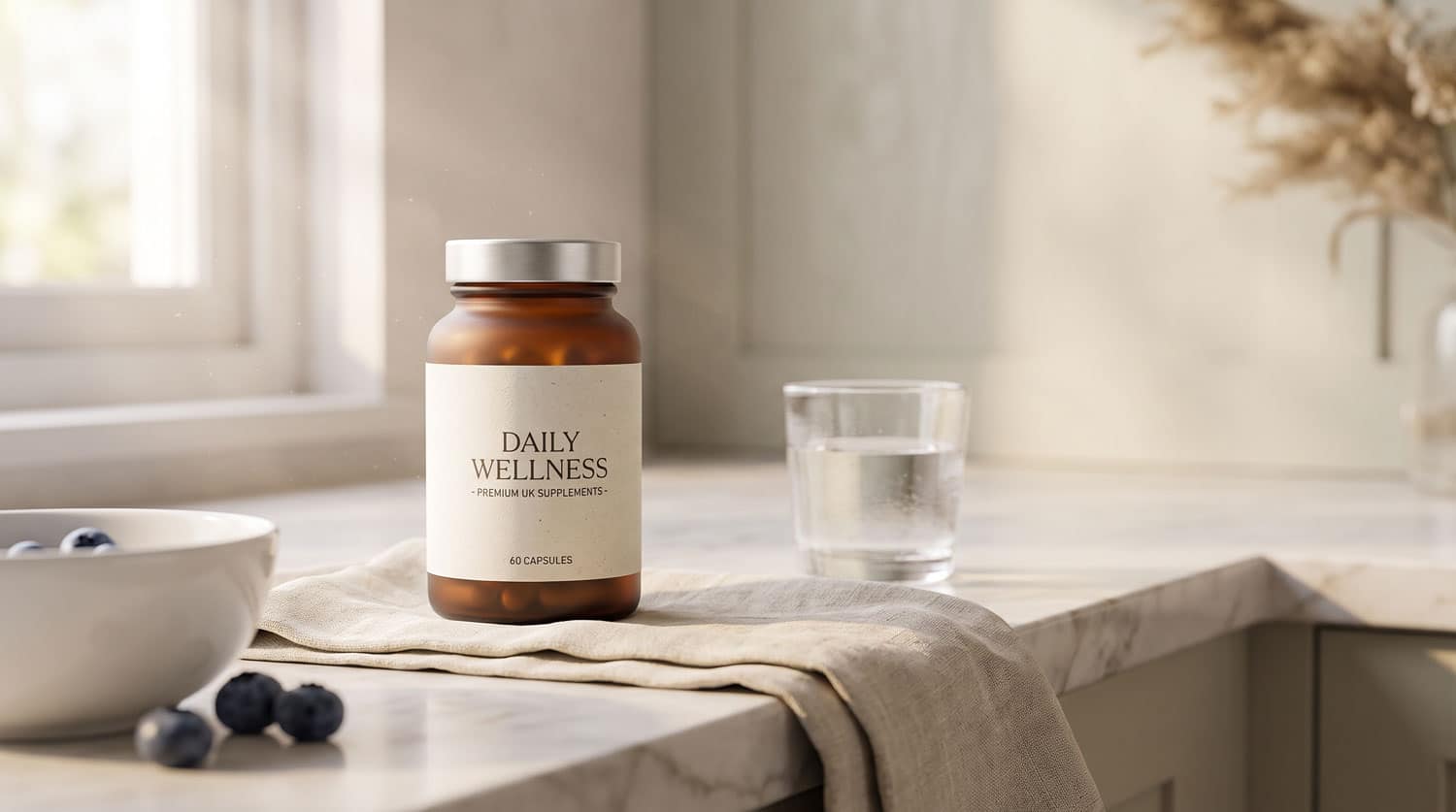
Lifestyle scene variations. The studio packshot is placed into different lifestyle contexts: a morning counter scene, a gym bag, a kitchen shelf. Each scene is generated from the real product image, so the product itself remains accurate.
-
Seasonal and campaign variants. A January wellness campaign, a summer sports nutrition push, and a Christmas gifting context all require different visual framing. With the base packshot in place, these can be generated quickly without commissioning additional studio time.
-
Flavour and SKU variants. When a new flavour launches, lifestyle imagery for the new SKU can be generated from the existing studio template. The scene, lighting, and composition remain consistent while the product changes.
-
Platform-specific crops and formats. Square for Instagram, portrait for Stories, wide for brand store headers: the same scene adapted for different aspect ratios and placements without reshooting.
The important distinction: AI handles scene extension and variation. It does not replace the studio shot for Amazon’s main image, for label accuracy, or for any primary product image where compliance is a factor. Used correctly, it multiplies the output from a single shoot rather than attempting to replace the shoot altogether.
The full hybrid photography workflow is covered in detail separately. It’s worth understanding the broader approach before deciding how much of your supplement photography budget to allocate between studio time and AI production.
How to Brief a Supplement Photography Studio
A well-written brief saves considerable time and avoids the most common reasons supplement photography misses the mark. Before engaging any studio, prepare the following:
-
Product inventory with packaging dimensions. Different container shapes require different lighting setups. Flagging a foil pouch alongside a glass bottle alongside a plastic tub in advance allows the studio to plan appropriately rather than improvising on the day.
-
Label condition requirements. Make clear whether all labels need to be legible in every shot or whether certain angles can show the label partially. Specify if nutritional panel shots are required as a separate deliverable.
-
Channel specifications. Amazon main image needs pure white background at RGB 255, 85% product fill, no props. DTC product pages have different requirements. Social needs different ratios. Give the studio the full list upfront.
-
Brand visual guidelines. If the brand has existing photography, share it so the studio can match tone, background treatment, and general aesthetic. Consistency across old and new images is often more important than any individual image being particularly strong.
-
Compliance considerations. If the product makes any specific health claims in copy, flag them so lifestyle imagery avoids accidentally reinforcing or undermining those claims visually. The studio cannot manage compliance it is not aware of.
Supplement Photography Costs in the UK
Costs vary considerably based on product complexity, the number of SKUs, and whether AI-enhanced lifestyle scenes are included. As a general guide:
-
Simple packshot sets (white background, 3-4 images per product) typically start from £50 to £80 per product at volume
-
Full Amazon listing sets (main image, secondary images, lifestyle) run from £150 to £250 per product depending on complexity
-
Range shoots covering 10 to 20 products in a single session are where studio rates provide real economies of scale: setup time is shared across the whole range
-
AI-enhanced lifestyle variations add cost-effective scale post-shoot: typically 30 to 50% of the equivalent studio cost for each additional scene
For a more detailed breakdown of what product photography actually costs and where the budget goes, the full UK product photography cost guide covers traditional and hybrid pricing in detail.
Common Supplement Photography Mistakes and How to Avoid Them
After working with supplement and wellness brands across a range of categories, the same problems come up repeatedly:
-
Photographing the product before labels are finalised. Label peeling, creasing, or misalignment on delivery cannot be fixed in post without significant retouching cost. Confirm labels are perfectly applied before the products go anywhere near a studio.
-
Using the lifestyle shot as the Amazon main image. This is a listing compliance failure and one of the most common reasons supplement listings get suppressed on Amazon UK. The main image must be a clean white background shot.
-
Inconsistent photography across flavour variants. If the chocolate flavour was shot twelve months ago by a different photographer, and the new vanilla flavour is shot today, the images will not match. Buyers who see both on the same page notice immediately. All variants should be shot in the same session wherever possible.
-
Neglecting secondary images. Brands frequently invest in a strong main image and then populate the remaining Amazon image slots with screenshots of the label or stock photography. The secondary images are where the purchasing decision happens for buyers who do not already know the brand.
-
Lifestyle imagery that implies health outcomes. A supplement placed next to a set of weighing scales implies a weight-loss outcome. A product photographed next to clinical equipment implies medical efficacy. These are compliance risks, not just visual choices.
For a broader look at where AI product photography workflows commonly go wrong — and how to avoid the same issues — see our guide to AI product photography mistakes.
Supplement Photography for Amazon UK: What the Main Image Must Get Right
Amazon’s main image requirements for supplements in the UK are specific and unforgiving:
-
Pure white background, RGB 255,255,255. Not off-white, not light grey, not a studio white that looks white on screen. The background must actually be white at the pixel level, because Amazon’s image checker reads the background colour.
-
The product must occupy at least 85% of the image frame. Products that leave too much white space around them will be flagged.
-
No text, no graphics, no logos other than those on the product packaging itself. No “new formula” banners, no “free shipping” badges, no lifestyle elements of any kind.
-
The product must show from an angle that makes the primary label legible. For supplement tubs, a slight front-facing angle usually works. For bottles, the label must face the camera.
These specifications apply to the main image only. Secondary image slots allow lifestyle photography, infographics, and ingredient imagery, within the health claims restrictions outlined above.
What to Look for When Choosing a Supplement Photography Studio
Not all product photography studios are set up to handle supplement work well. When evaluating options, the questions that matter are:
-
Can they show examples of supplement photography specifically? Not beauty products, not general packshots: supplement tubs, bottles, and pouches with label detail visible and reflective surfaces controlled.
-
Do they understand Amazon’s main image specifications? A studio that produces technically excellent images without understanding the 85% fill requirement or the pure white background spec will still cause listing problems.
-
How do they handle multi-SKU ranges? The logistics of photographing fifteen products in a single session require planning and system. Ask how they keep products consistent across a long shoot day.
-
What is their approach to AI-enhanced lifestyle scenes? This should be an optional add-on with clear explanation of where real studio photography is required versus where AI can extend the asset library. Studios that offer AI lifestyle scenes without a studio foundation are cutting a corner that matters.
The comparison between traditional and AI-enhanced approaches is worth understanding in detail before any purchase decision. The honest UK comparison of AI and traditional product photography covers exactly where each approach adds value and where it does not.
Get a Quote for Supplement Product Photography UK
Products Photography UK handles supplement product photography in the UK from our West Midlands studio, with AI-enhanced lifestyle production built into the workflow for brands that need more than a packshot set. Whether you have five products or fifty, a single Amazon listing or a full DTC store refresh, we can scope the project and turn it around in two weeks. Get in touch to discuss your requirements and get a fixed-price quote.
Frequently Asked Questions
How long does a supplement product photography shoot take?
A single-product packshot set with two or three configurations typically takes two to three hours including setup, shooting, and a basic review pass. A multi-SKU range shoot covering ten to fifteen products would usually run a full studio day. Turnaround for processed and delivered files is typically two weeks from shoot day.
Can AI-generated lifestyle scenes be used on Amazon UK for supplements?
AI-enhanced lifestyle imagery can be used in Amazon’s secondary image slots, provided it does not make unauthorised health claims and accurately represents the product. The main image must always be a real studio photograph on a pure white background. Amazon’s specification explicitly requires this, and the requirement applies regardless of whether the rest of the listing uses AI imagery. For the full picture on what Amazon allows, the AI product photography on Amazon UK guide goes into the relevant rules in detail.
My product has a reflective foil label. Will the studio be able to photograph it cleanly?
Yes, but it requires specific lighting setup. Foil and metallic labels create hot spots under direct light and need diffused or edge lighting to read cleanly. A studio that regularly handles supplement and beauty packaging will have the equipment and technique to manage this without the label becoming illegible or glared out in the final image.
Do I need to send the products to the studio?
Yes. AI image generation can extend an existing library, but there is no substitute for photographing the real product under studio conditions for primary images, Amazon compliance shots, and any imagery where label accuracy matters. We arrange a direct send from you or your fulfilment centre. Products do not need to come from you personally.
How many images do I need for a complete Amazon supplement listing?
Amazon allows up to nine images plus a video per listing. A complete supplement listing typically uses: one white background main image, one angled secondary packshot, one label close-up showing the nutritional panel, two or three lifestyle or context images, and one or two infographic images highlighting key benefits or usage instructions. That is seven to eight images minimum for a listing that competes with established brands.
Can you match the photography style of images I already have?
In most cases, yes. Share examples of your existing photography before booking and we can review whether the lighting style, background treatment, and general aesthetic can be matched. For large ranges where some products were shot years ago, exact matching is more difficult, and a full re-shoot of the range in a consistent style is often the cleaner option.
What formats will I receive the final images in?
Final images are delivered as high-resolution JPEG files, web-optimised for loading speed, and formatted to the specifications of each platform the images are intended for. Amazon main images are delivered at the correct pixel dimensions and background specification. DTC and social formats can be cropped and exported to order.
Written by Dee Patel, founder of Products Photography UK. 16 years of commercial photography experience, now applied to AI-enhanced product imagery for UK e-commerce brands and Amazon sellers.

Written by Dee Patel
Dee Patel is the founder of Products Photography UK, a West Midlands studio specialising in professional product photography and AI-enhanced imaging. With 16 years of commercial photography experience, Dee works with UK e-commerce brands, Amazon sellers, and B2B businesses across fashion, cosmetics, supplements, and more. Read Dee’s full profile →
Recent Comments