
yle>
.entry-content p,
.entry-content li,
.entry-content td,
.entry-content th {
font-size: 18px;
line-height: 2.2em;
}
.et_pb_post {
margin-left: 90px !important;
margin-right: 30px !important;
}
AI product photography vs traditional studio photography is one of the most-asked…
AI product photography vs traditional studio photography is one of the most-asked questions we hear from UK e-commerce brands right now, and the answer is rarely the one they expect. It is not that one approach is better. It is that most brands are using the wrong one for the wrong jobs, and paying for it in returns, re-shoots, or missed opportunities.
Products Photography UK has run hybrid photography workflows, combining studio production with AI image generation, since before most brands had heard of the tools involved. This guide is not a theoretical comparison. It is built on what we see working, and failing, in real commercial projects across fashion, beauty, homeware, and food.
If you are trying to decide whether AI product photography is right for your brand, or whether your current studio setup is costing you more than it should, what follows will give you a clear answer.
What We Mean by AI Product Photography vs Traditional Photography
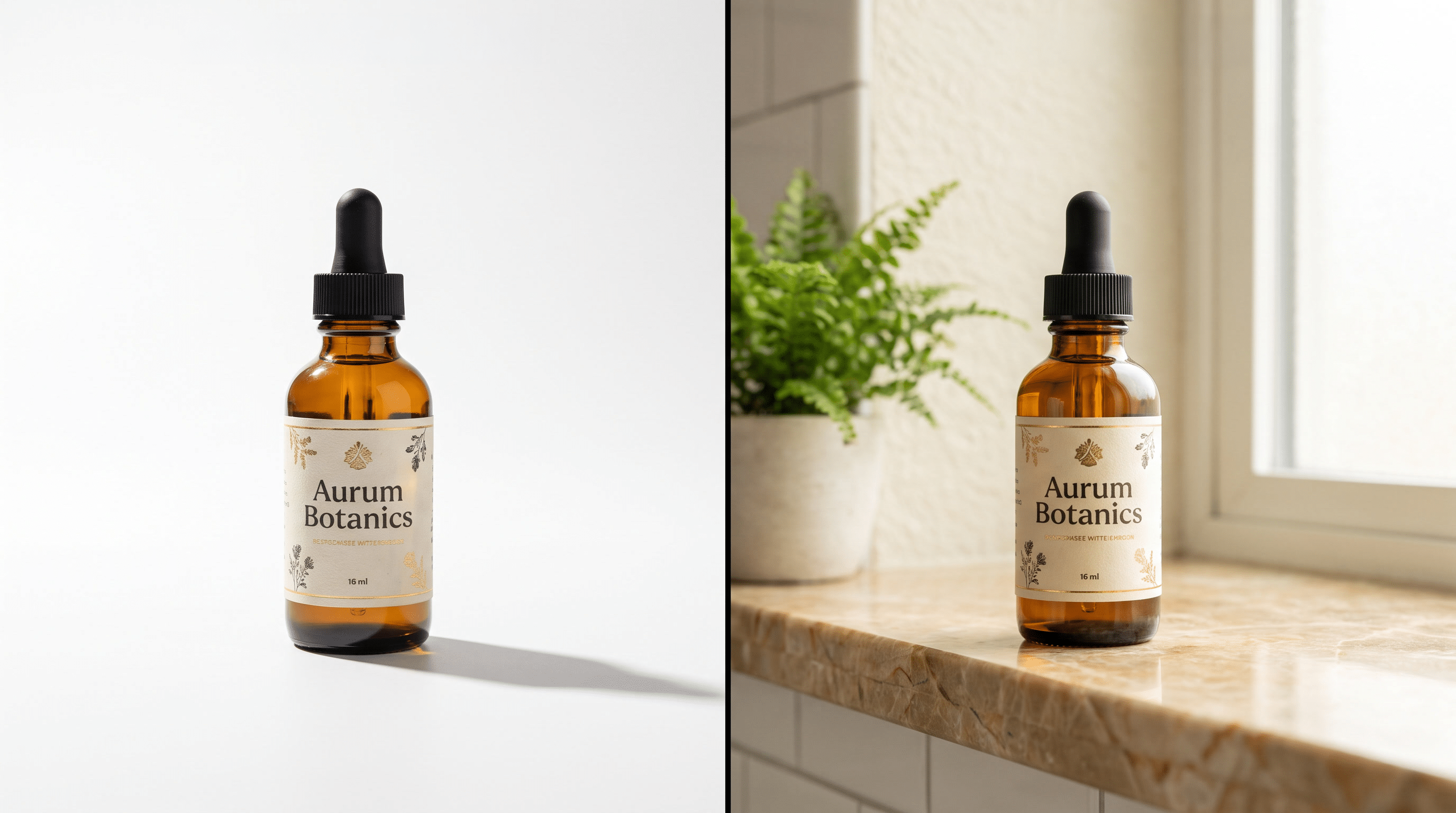
Traditional product photography means a physical shoot. A product arrives at a studio, a photographer sets up lighting, background, and composition, captures the image, and a retoucher prepares the final files. The camera records exactly what exists in front of it.
AI product photography generates images from reference material. You provide photographs of the product, and an AI model builds scenes, environments, and compositions around it. The output is a synthesised image, not a photograph of a physical setup.
The important distinction: AI product photography at a professional level is not an app that removes backgrounds. It is a production process that requires strong reference images, prompt engineering, quality assurance, and understanding of platform compliance requirements. The entry-level tools exist, but they produce entry-level results.
A third category matters here: the hybrid approach. This combines studio photography for the product anchor (the clean, accurate, controlled image of the product itself) with AI generation for context, lifestyle scenes, variant creation, and content volume. This is where most serious commercial work now sits.
The Honest Comparison: Cost, Speed, and Quality
Cost
Traditional photography costs vary considerably by product type and output requirement. A product studio shoot in the UK typically runs from £300 to £800 per half-day for the shoot itself, plus retouching at £20 to £60 per final image. For a 50-SKU catalogue with three images per product, you are looking at several thousand pounds before additional lifestyle content.
AI product photography tools have a very different cost structure. The tools themselves are subscription-based, ranging from £30 to £150 per month for serious commercial use. The cost per output image is low. But the time investment in reference photography, prompt development, and QA is not zero. Professional AI production requires skill and workflow discipline.
The hybrid model sits between them on upfront cost but typically delivers a better return. One studio shoot produces the reference assets that power months of AI content creation. Brands running this way spend less per image over a 12-month period than those relying exclusively on traditional shoots for every content need.
Speed
Traditional photography timelines are set by logistics. Booking the photographer, shipping product to the studio, the shoot day itself, post-production and retouching: a realistic timeline from brief to final files is five to fifteen working days for a standard project.
AI generation is fast at the output stage. Once the reference photography exists and the workflow is established, producing lifestyle variants, seasonal adaptations, or platform-specific crops takes hours rather than days. The front-loaded investment is in the reference shoot and workflow setup.
For brands with ongoing content needs, this compounds quickly. A fashion brand needing weekly new content for social cannot shoot traditionally every week at commercial rates. AI generation from a strong reference library makes that volume achievable.
Quality and Material Fidelity
When brands research AI product photography vs traditional photography, this is where the comparison gets more specific, and where the limitations of AI matter commercially.
For straightforward products on plain backgrounds, AI generation quality in 2026 is high. Clean shapes, non-reflective materials, and simple compositions produce reliable results. The image looks professional and platform-compliant.
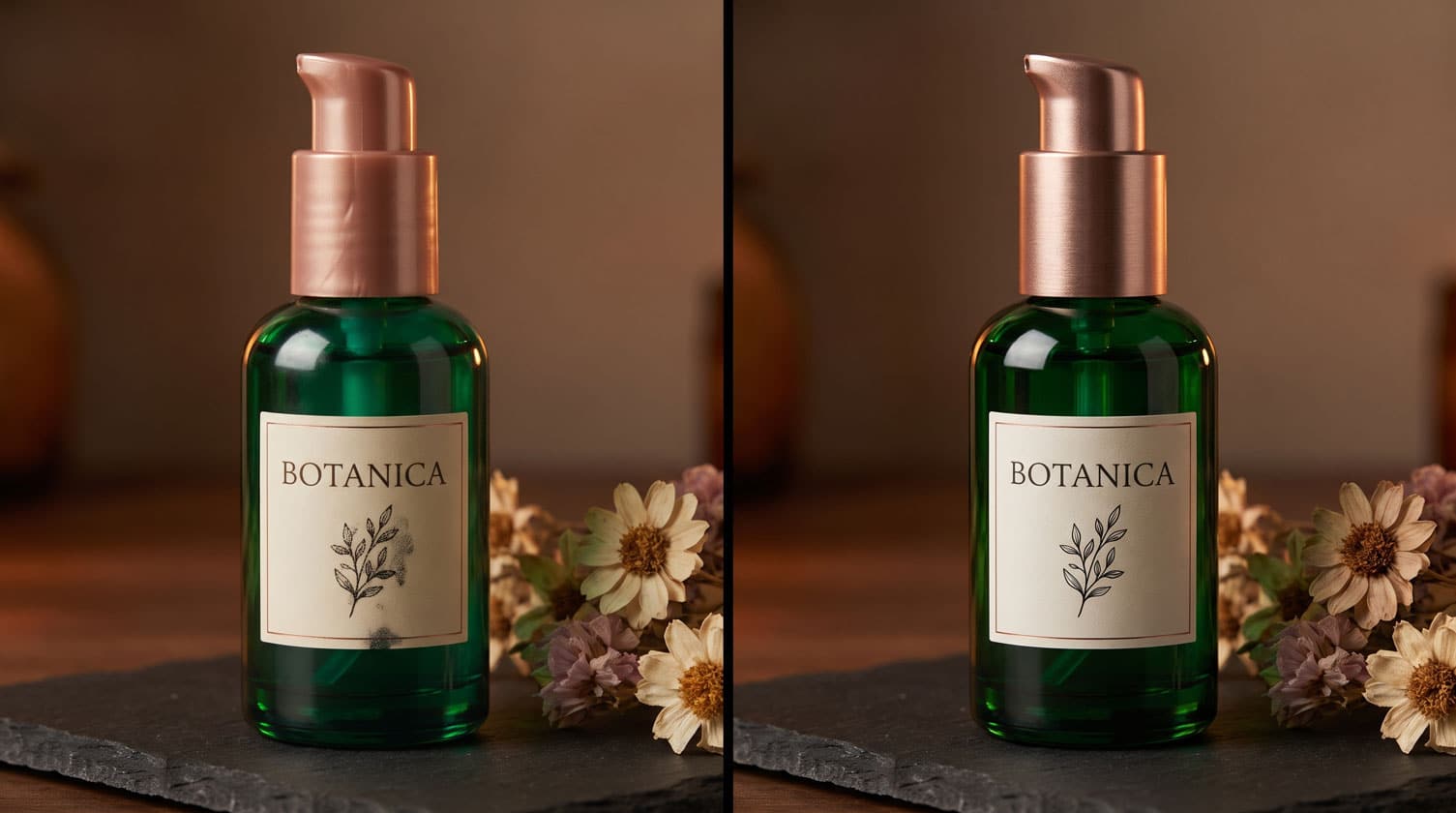
The problems emerge with specific material types. Reflective surfaces (glass, polished metal, patent leather) are difficult for AI to render accurately. Transparent products, particularly glass bottles and packaging, frequently produce results that look plausible but are physically wrong. A perfume bottle rendered by AI may have the right shape and colour but incorrect reflections, light transmission, or meniscus. A buyer who receives the product and finds the glass looks different from the image will return it.
Textured materials present similar challenges. Knitted fabrics, suede, matte ceramics with irregular surfaces: AI struggles to hold the texture accurately across a full image set. The first image in a sequence may look right. The tenth will drift.
Traditional photography captures what exists. The glass bottle is exactly as it appears. The knit texture is exactly as it feels. There is no interpretation, no synthesis, no drift across a product range.
Where AI Product Photography Wins Outright
These are the use cases where AI generation delivers results that traditional photography cannot match, not just on cost but on practical output.
- Lifestyle scene generation at volume: a product photographed once in studio can be placed in dozens of different lifestyle environments without a single location shoot. For homeware, food, and beauty brands this changes what is commercially viable.
- Seasonal content refresh: Christmas backgrounds, summer scenes, seasonal colourways. AI produces these from existing assets in hours. Booking a studio and dressing a set for each season is not a workable alternative at scale.
- Platform-specific variants: Amazon requires different image specifications from Shopify, from Instagram, from ASOS. Resizing and adapting core assets for each platform is work AI handles efficiently.
- On-model fashion imagery at volume: for brands with large SKU counts, AI on-model generation from reference photography is now commercially viable. Products Photography UK has run this workflow for a fashion client with over a thousand products per year. The output is consistent, controllable, and produced at a fraction of what a model shoot per collection would cost.
- A/B testing creative: generating multiple scene variations to test in paid social requires more images than a traditional shoot can economically produce. AI makes test volume achievable.
Where Traditional Photography Still Leads
There are product categories and use cases where traditional photography is not optional, regardless of how good AI tools become.
Products Where Material Accuracy is Non-Negotiable
Jewellery, crystal, glass, polished metal, transparent packaging, and textiles with complex weave or finish require camera capture to represent the product accurately. AI will produce something that looks like the product. It will not produce an accurate record of the product. For categories where the physical appearance is the entire purchase decision, that distinction matters.
Hero and Campaign Imagery
A brand’s primary visual assets (the images used on a homepage, in print, in broadcast media, or in premium retail contexts) are not the place for AI generation. They require craft, creative direction, and intentional composition. A photographer working with a product in a real environment makes decisions about light, angle, depth of field, and moment that AI cannot replicate from a brief. These images define how a brand is perceived and are worth the investment.
Regulated Categories
Food and drink products with specific label claims, pharmaceuticals, supplements, and products subject to Trading Standards requirements need imagery that accurately represents the physical product. Using AI-generated imagery that misrepresents size, colour, or composition introduces legal and compliance risk. Traditional photography, with proper QA, is the safer route.
Products You Have Not Photographed Yet
AI generation requires reference photography. A product for which no professional images exist cannot be AI-generated to commercial standard. The first step is always a camera and a controlled environment. This is sometimes missed in the enthusiasm for AI tools: every AI workflow starts with real photography.
The Case for the Hybrid Approach
The question UK brands actually need to answer is not whether AI or traditional is better. It is how to use both in the right proportions for their specific product range and content requirements. Our AI-enhanced product photography guide covers exactly how to build that workflow in practice.
The hybrid model works as follows. A studio shoot produces the product anchor: clean, accurate, fully retouched images of the product itself in controlled conditions. These serve as the reference assets for everything that follows. AI generation then builds out the content library, covering lifestyle scenes, contextual environments, seasonal variants, on-model imagery, and social formats. The product in the AI-generated image is the studio-photographed product, so fidelity is maintained. The scene is AI-generated, so it is fast and cost-efficient.
This approach also future-proofs the asset library. When a new platform requires a different image type, or a campaign needs a fresh context, the reference photography already exists. No re-shoot required.
The results are different in character from either pure AI or pure traditional approaches. The product looks exactly right because it was captured in a real environment. The scene looks relevant and contextual because AI generated it to match the brief. Customers get an accurate representation of what they are buying in a compelling visual context.
Here is how the approaches compare across the dimensions that matter most for a UK brand:
| AI-only | Traditional studio | PPUK hybrid | |
|---|---|---|---|
| Setup time | Minutes (reference images needed) | Days to weeks (booking, shipping, scheduling) | 2-5 days (shoot + AI production) |
| Cost per image | Low (tool costs only) | £25-£150+ per finalised image | Mid-range, volume efficiency built in |
| Material accuracy | Inconsistent on reflective, transparent, complex textures | Exact, camera captures what exists | Exact, studio anchor with AI for context and variation |
| Scalability | High, hundreds of variants from one reference | Low, each shoot is a separate project | High, one shoot generates extensive asset library |
| Brand consistency | Requires careful prompt discipline | Dependent on photographer briefing | Built into workflow, consistent across all outputs |
| Platform compliance | Risk without QA, misrepresentation possible | Safe if shot to spec | QA stage built in, compliance checked before delivery |
| Best for | Secondary lifestyle variants, seasonal content, social ads | Hero shots, launch imagery, luxury editorial | UK brands wanting both: accuracy plus volume |
When to Use Each Approach: A Practical Decision Guide
The right choice depends on your product type, content volume, and where in the buyer journey the images appear.
| Situation | Recommended approach |
|---|---|
| New product launch, hero imagery | Studio photography (traditional or hybrid anchor) |
| 50+ SKUs needing lifestyle variants | Hybrid: shoot anchor images, AI generates scenes |
| Seasonal content refresh | AI-led from existing reference photography |
| Reflective, transparent, or textured products | Studio shoot essential, AI alone will introduce errors |
| Fashion, on-model imagery at scale | AI on-model from studio reference, strong ROI |
| Budget under £500, simple product | AI with careful QA, manageable risk at low volume |
| Luxury, premium, or regulated product category | Studio-led hybrid, accuracy and compliance non-negotiable |
What Good AI Product Photography Actually Requires
The gap between AI product photography vs traditional photography that works commercially comes down to inputs and process, not tools. Understanding what each approach actually requires is what separates good commercial decisions from expensive mistakes.
Strong Reference Photography
AI generation is only as accurate as the reference it works from. A blurred, poorly lit, or low-resolution reference image will produce AI outputs that reflect those problems. Professional reference photography (even a simple clean studio capture) sets the quality ceiling for everything that follows.
Prompt Discipline
Professional AI image generation requires consistent, structured prompting. Without prompt discipline, outputs drift in lighting, perspective, and colour across a product range. Brands managing AI production in-house without a defined workflow quickly find their image sets are inconsistent, which undermines brand presentation and can trigger platform compliance flags.
Platform-Specific QA
Every major selling platform has image requirements. Amazon’s technical standards, Shopify’s presentation guidelines, Meta’s ad specifications: all have rules about background colour, image dimensions, product representation accuracy, and prohibited content. AI-generated images that pass a quick visual check can still fail platform QA if the product is misrepresented, the background is not true white, or dimension proportions do not match the actual product.
A photographer who has worked commercially for 16 years looks at an AI-generated image differently from someone checking whether it looks good on a phone screen. The commercial eye catches the reflection that is wrong, the label text that has drifted, the colour that is slightly off against the product specification. That check is not optional. It is what separates AI product photography that performs from AI product photography that generates returns.
Common Questions About AI vs Traditional Product Photography
Is AI product photography allowed on Amazon UK?
Yes, with conditions. Amazon permits AI-generated images provided they meet its technical image requirements and accurately represent the product being sold. The key compliance requirement is that the image must not misrepresent what the customer receives. AI-generated images that alter colour, size, or material appearance relative to the actual product violate Amazon’s policies and can result in listing removal. A photographer-reviewed QA process is essential before publishing AI-generated images on Amazon. For a full breakdown of what is and is not permitted, see our guide to AI product photography on Amazon UK.
Can AI product photography replace a studio photographer?
For specific tasks, yes. Lifestyle scene generation, seasonal variants, and social content at volume are areas where AI delivers results that would be impractical to produce through traditional shoots. For hero imagery, material-accurate catalogue photography, and campaign-level creative, a photographer’s input remains necessary, either to capture the product itself or to direct and quality-assure the AI output.
How much cheaper is AI product photography than traditional?
Cost comparisons vary significantly by use case. For a 50-SKU lifestyle image set, AI production can cost 70 to 90 percent less than a traditional location shoot. For a clean product catalogue requiring accurate material representation, the cost difference narrows because the studio capture stage is still necessary. The real savings come in content volume: AI allows brands to produce three or four times the image output from a single studio investment. For a full breakdown of what UK product photography actually costs, see our guide to product photography costs in the UK.
What products are not suitable for AI photography?
Products where material accuracy is commercially important and difficult to reproduce in AI: glass, crystal, highly reflective metals, transparent packaging, complex textiles, and fine jewellery. Products in regulated categories (food and drink with specific label claims, supplements, pharmaceuticals) where image accuracy has legal implications. And any product for which professional reference photography does not yet exist.
How long does a hybrid product photography project take?
A typical hybrid project with Products Photography UK runs as follows: studio shoot and delivery of edited anchor images within three to five working days, followed by AI lifestyle generation and QA over three to seven working days depending on output volume. For a 50-product range with five images per product, allow two to three weeks from shoot day to final delivery of the full asset set.
Do I need to disclose that my product images are AI-generated?
UK distance selling regulations require that product images accurately represent what the customer receives. There is currently no legal requirement to label images as AI-generated, but the EU AI Act (which UK sellers trading into Europe must consider from 2026) includes provisions around disclosure of AI-generated content in commercial contexts. The compliance question is less about the label and more about accuracy: if the AI-generated image accurately represents your product, the legal risk is low. If it does not, the label does not help you.
Can I use existing product photos as AI reference images?
Yes, and for brands with an existing catalogue this is often the most efficient starting point. Existing studio images can serve as reference photography for AI lifestyle generation without a new shoot. Quality matters: the reference images should be sharp, well-lit, and ideally on a clean or neutral background. Phone photographs taken in a warehouse are not suitable reference material for commercial AI production.
Get a Quote for AI-Enhanced Product Photography
Products Photography UK works with UK e-commerce brands, Amazon sellers, and fashion businesses across the country. Whether you are looking to build a hybrid photography workflow from scratch, generate lifestyle imagery from existing assets, or understand which approach makes sense for your product range, we can put a clear proposal together.
Request a free, no-obligation quote from the PPUK team →
About the Author
Dee Patel is the founder of Products Photography UK, a West Midlands studio specialising in professional product photography and AI-enhanced imaging for UK e-commerce brands. With 16 years of commercial photography experience, Dee works with brands across fashion, beauty, homeware, and food, combining studio production with AI image generation tools to deliver visual content at commercial scale. All content on this blog is written or reviewed by Dee Patel.

Written by Dee Patel
Dee Patel is the founder of Products Photography UK, a West Midlands studio specialising in professional product photography and AI-enhanced imaging. With 16 years of commercial photography experience, Dee works with UK e-commerce brands, Amazon sellers, and B2B businesses across fashion, cosmetics, supplements, and more. Read Dee’s full profile →
Recent Comments